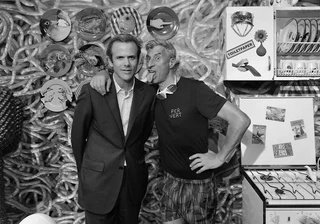
What happens when the sacred is stripped of its solemnity and reimagined as playful irony? The
Guframini God, born from the irreverent collaboration between
Cattelan & Ferrari for Gufram, delivers the answer in radical miniature form. At 1:8 scale, this collectible condenses the audacity of the original
God piece into an object that unsettles, amuses, and provokes. Monumentality becomes pocket-sized, reverence turns into parody, and seriousness dissolves into playful absurdity. In its reduced form,
God continues to embody
Toiletpaper’s sharp fusion of humor, critique, and design culture.
Material and Craftsmanship
The
Toiletpaper God miniature is made of
polyurethane, finished in a striking green that amplifies its surreal, cartoon-like quality. Its bold sculptural volume exaggerates proportion while remaining lightweight and tactile. Hand-finished with precision, every detail echoes the full-scale original, ensuring the miniature carries the same ironic punch and visual impact. Here, divinity is turned into anti-design: a symbol of worship reinterpreted as satire, highlighting
Gufram’s tradition of challenging function, form, and meaning.
A Collectible in Context
As part of the
Guframini collection, the
God mini stands alongside other similar products from the
Cactus collection by
Guido Drocco & Franco Mello, creating a cabinet of curiosities where art, irony, and design converge. It also resonates with the theatrical provocations of the
Studio 65 x Gufram collection and it pairs effortlessly on top of any
Gufram low table. Wherever displayed, on a shelf, in a gallery, or within a design collector’s archive, this miniature injects humor and irreverence into its surroundings.
A Radical Testament
Owning the
Guframini God means embracing
Toiletpaper products’ ability to dismantle conventions and transform symbols of power into playful commentary. More than a decorative collectible, it is a statement: a cultural artifact that captures the provocative essence of
Cattelan and Ferrari’s vision. Within the
Guframini series, it remains one of the boldest gestures, proof that Radical Italian Design thrives on contradiction, irony, and the unexpected, even at a miniature scale.